Digimon Adventure: Last Evolution Review

By MARK WILSON
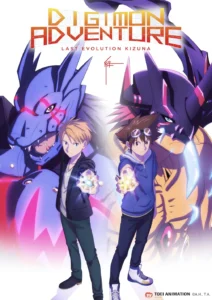
This is a review of Digimon Adventure: Last Evolution Kizuna, released in 2020.
This is a gaming site, but since it’s also just whatever I want to discuss, occasional forays into other media occur. This particular review was one that just happened to escape the bounds of my more-typical Letterboxd mini-reviews.
Sometimes it also takes these things a while to reach my attention across the Pacific, since Digimon certainly has US-based fans but is bigger in Japan. So here we are, several years after it’s release.
It will be impossible to remove my bias as a lifelong Digimon fan from this, but this is also a movie created for those fans. Anyone without that bias is outside the intended audience.
Good as I believe the movie is, there’s nothing to see here for those who weren’t fans of the original series 20+ years ago, and haven’t followed it through Digimon Adventure tri., the midpoint story for the franchise’s original cast.
This one being the send-off, presumably. Or at least the closing of a particular chapter.
Digimon was always a show that aimed at a higher maturity level than its one-time rival, Pokemon. Pokemon has remained largely static next to Digimon, which is unafraid of moving characters forward in ways seen too little in big franchises that are determined to siphon every last dollar out of their properties, and willing to reboot everything to keep it in stasis.
Of course, some flexibility is expected. The original show’s fans have aged around 25 years at this point, but Digimon’s protagonists are, perhaps, around 10-12 years older than they were in the original. Still, this allows for metaphoric maturation of the characters along with the audience, even if the literal timeline isn’t mapped exactly to ours.
Here, the theme is letting go.
Overall, the movie is well crafted, visually and narratively. It’s largely received praise, though there are some detractors (when isn’t there?). I won’t dwell overlong on some elements, since I think it will be more interesting to explore the movie’s ideas rather than its execution. You already know if you’re interested or not in watching it, likely, or already have and are just looking at someone else’s take on it.
Spoilers Ahead
The major revelation is that the Digi-Destined age out of their companions, which disappear when the potential they possessed as children is more fully realized in adulthood, or at least at the threshold to adulthood.
It’s pure fantasy, but works within the show’s mythos. Throughout its history, a Digimon’s power has always been linked to the human companion’s inner growth. It’s the throughline that drives the show, and so it makes sense to show actual growth and change in its characters, which the movie does a nice job of portraying.
Matt and Tai – the focal point of the story – still have hints of their former animosities. But they share a beer in an early scene that lets you know they’ve moved past such pettiness; they can see past disagreements to the bond they share. Not all the characters receive such personal moments, but they’re all hinted at to some extent.
It’s also far from the first time this theme has been explored in film and TV, though it’s one worth revitalizing for new audiences.
A shallow reading of the plot might lead you to think this is the creators telling us we need to leave childish things in childhood. There’s the famous C.S. Lewis quote about this that makes the rounds in such discussions, which is an affirmation of so-called childish pursuits into adulthood, and actually chastises those who would leave their childlike playfulness behind.
I don’t think leaving behind childlike behavior is the film’s message, though. Because the other side of that argument is that there really are things we need to leave behind, or perhaps adopt, to grow in our lives. A sense of responsibility, social, civic, ethical, romantic, professional, and more. A confidence in who we are and how we want that persona to manifest in the world. And more along these lines.
A lot of that really is childhood potential coalescing into something concrete.
It also means leaving behind some things. Conceptual things, perhaps, and not at the expense of so-called “childish” pursuits. But if you adopt a sense of responsibility about something, for example, you’re leaving behind certain carefree freedoms that typify youth. If you’re establishing an outward persona that you’re happy with, you’re divesting some experimentation with worldviews and approaches to life.
And in the metaphoric world of Digimon, where bonds are linked to these conceptual traits, the story asks us what we leave behind at different transitions in our lives. What have we already given up? What haven’t we let go of yet that we might be better off ridding ourselves of? What should we strive to retain from those earlier portions of our lives? Or regain, if we’ve already lost them?
The movie’s villain fails to let go; this is mirrored by Tai and Matt, whose journeys allow them enough grace to move on with an optimistic, if bittersweet, outlook. The message is clear, and is powerfully delivered.
It’s also a real feeling. On vacation when I was a pre-teen, I made myself a custom necklace at a beachside shop, one that said “DigiDestined” on it. Because I identified with these characters so strongly that I saw myself as one of them. Millions of others did the same. It’s why the IP has endured.
Nearly 30 years later, as I write this, I have a day job, a dozen former hobbies, friends I’ve fallen out of touch with, looming political fears and day-to-day stresses not dreamt of by that kid. More serious, adult stresses than those faced by the characters in the film, but the gulf is not so wide that we can’t still identify with them. Matt and Tai’s anxiety about their upcoming adult lives are proxies for the anxieties about our lives that never truly went away for us after they first appeared in those formative young-adult years.
And in reflecting on my journey, there’s a sense of loss as well. Where did the DigiDestined go who made that necklace? Is he still in there? Or am I the maturation of that child, retaining the core vitality that I so loved about the show and in my own spirit?
I am happy in my life, for clarity. But look at your 12-year-old self and then at your life today. Much has changed. Much has been let go. And some things have been sacrificed for the sake of that change.
Much of that is good, again for clarity. But a reflection on this change, and the thousands of smaller changes that make up this whole, is what is demanded by the story. Are you clinging to some sort of nostalgia, or have you allowed your experiences to give you confidence to move forward into the unknown, into more changes?
As much as the movie seems like nostalgia-bait on the surface, it’s telling us that those memories served a purpose and that it’s a fool’s errand to try to recreate them perfectly. The same context no longer exists, and so something about it will always feel a little unsatisfying in the present day.
It’s a lesson a lot of movie studios could stand to learn (and TV studios and other forms of media, for that matter), and I’m guessing a lot of people as well.
Allow your characters to mature with their audience, and the audience will reward you. Similarly, allow yourself to mature in ways that shed some of what you once held dear, and you may be able to transition optimistically to new adventures.
That the actual sendoffs are likely to make longtime fans teary-eyed is another point in the movie’s favor. It’s not entirely without some awkward narrative framing, or occasionally stilted lines of dialogue (though some of that may come down to translation issues).
There’s a moment where one character likens the hesitance of talking about Digimon companions leaving forever to the hesitance we have in talking about how much time we have left to live. The scenes themselves could be viewed as a softened depiction of the death of a loved one, and indeed it has a similar amount of emotional impact to some death scenes from powerful films.
The kid gloves aren’t entirely off, in other words, but there’s a respect for the intended audience in realizing the true and lasting loss that is sometimes felt at moments of great transition. That it finds hope and optimism through it is indicative of the franchise’s tone, and also on point with the show’s overarching messages about personal growth and the bonds of friendship.
In more concrete terms, the production, music, voice acting (I watch with English dubs since those are the voices I grew up with) and direction is all on point. The animation is lovely, and several moments feel authentic to the franchise. Even the “B Team” from Season 2 of the original show gets some love. They aren’t the focus, but neither are they relegated to blink-and-you’ll-miss-it cameos. Their relationship with the protagonists serves to further the interpersonal dynamics, albeit in small ways.
One of my favorite scenes in this regard is also one of the quietest. Matt, having come into his own as a natural leader, has a brief phone conversation with the American-based younger squad. It’s clear they trust and respect Matt, who treats them as equals in an easy manner befitting someone whose journey has given him skills and experience worthy of trust. It feels effortless, and unless you think back to Matt at an earlier age, it’s easy to take for granted how naturally they’ve shown this character progression.
He’s grown. So have we, likely in too many subtle ways to realize either unless we stop and think about it.
I will always have a fondness for Digimon, but it’s been an unexpected pleasure that it has attempted to mature along with its audience across the decades, delivering emotional stories in ways a return to the original never could at this point. It’s not always perfect, but even with some stories that struggle a bit with pacing and tone (like the Digimon Adventure Tri. storyline mentioned above), there’s an emotional core that’s never wavered.
If this film is the last I see of these characters, I’m content. It’s been a cool adventure.
…
Like my content and want more? Check out my other reviews and game musings!
Read More From BTD
Recent Posts
Categories
- All (370)
- Announcements (4)
- Board Games (217)
- DMing (29)
- Game Design (21)
- Playing TTRPGs (22)
- Reviews (203)
- RPGs (145)
- Session Reports (92)
- Why Games Matter (13)