Toy Battle Board Game Review

By MARK WILSON
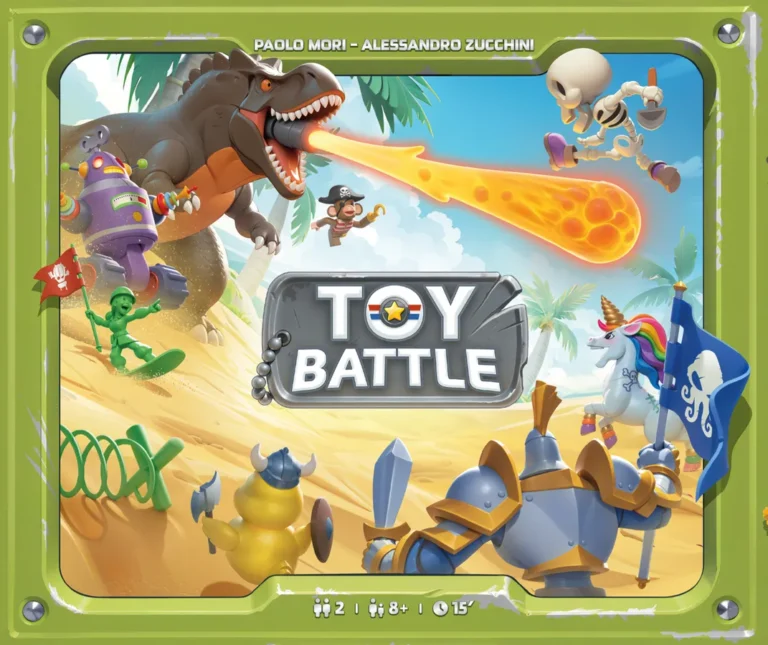
Game: Toy Battle
Released: 2025
Players: 2
Playtime: 15-20 min.
Toy Battle. It’s not just the name of the game. It’s also an ethos.
What comes to mind when you imagine the phrase “toy battle.” Probably kids on their living room carpet, stomping around with dinosaurs and Hot Wheels and Transformers, or perhaps less branded toys like pencil cases and collections of string.
I used to have a battle royale between my school supplies in middle school study hall when I was bored. The protractor had all the coolest special moves, but sometimes lost to the brute force of my glue bottle or scissors.
Somewhere in our lives, this unbounded play needed to become more bounded. Why? I’m unsure. An improvisational exercise where I represent a protractor in a cage match against a pencil sharpener sounds pretty funny to me. Or using pool noodles as proxies for troops as we play capture the flag in a public pool. But rules were superimposed onto our play. Sports. Exams. And table games.
Toy Battle – the game – recreates some of this joy. It remembers that this stuff is supposed to be fun, in the immediate, visceral way that defies rational explanation. We just feel it. With my more complicated games, I tend to dissect why a game provides fun.
Here? I just dive-bombed your rubber duck with my T-Rex and I’m one step away from capturing your headquarters: a flotation device at the far end of a swimming pool. That sort of shit doesn’t need to be rationally explained. You instinctively understand why it’s fun.
Toy Battle – the Premise
On one of several boards, you build out from your base with your “troops,” a motley assortment of toys (robots, ducks, dinos, toy soldiers, skeletons, etc.), each of which has a number value and a small ability they can perform when played. On your turn, you either play one or draw more from your supply.
To win, you either capture more stars (which exist in surround-able areas) or you build into your enemy’s base at the other end of the map.
The powers and abilities shake things up, allow for cleverness and surprise, and the maps often come packaged with small quirks that offer new tactical opportunities in the form of spatial maneuvers or minor abilities.
The push and pull of “base capture” vs. “star-based victory” dries a lot of the tension, since you can rarely advance and defend against both of those goals at once. Every advancement comes with potential risk.
There are shades of designer Paolo Mori’s earlier designs, such as Caesar: Seize Rome in 20 Minutes. You can see the evolution in design thinking that’s happened, one that involves a lot of interesting tug-of-war style tactical maneuverings. Toy Battle loosens the belt a little bit and has more fun with itself. Perhaps it sands off the most nuanced of strategic and tactical options of some of his earlier titles in doing so, but it’s also more likely to inspire the unbridled joy that comes with chaos in games.
Why I Love Toy Battle
I can’t really play coy here. This game is a delight. So long as your concept of “delight” involves muttered curses and exasperated sighs as your opponent foils your carefully laid plans in one of several ways.
A game could last all of 10 minutes once you know it well. The maps provide ample variance to shake things up, but the core structure is plenty rewarding for numerous plays.
The draw order of your toys can be lucky (or unlucky), but the tactical and strategic opportunities available are more nuanced than the premise might imply. I find myself crunching tactical possibilities a fair amount, even as the overarching experience is one that feels more instinctive and casual.
Here in the year 2025 (as I write this), this is competing for my most-played game of the year for me, and also best new-to-me game of the year. It may not receive that top distinction, but if it doesn’t, it’ll only be because I found others that are equally amazing games for me.
Possible Flaws
There’s only one set of characters for players, and some have pined for additional sets to play with, which could add additional variance.
While I can’t deny that it might be nice, I can only reply to say that I haven’t tired of them across a couple dozen sessions.
The same holistic sense of deja vu could also set in with enough plays. I love the tensions that the two victory conditions provide as they sort of pull players in opposing directions.
I tend to think that if you’re playing a game so much that it feels a bit same-ish after a while, it hopefully means you’re getting a lot of use out of it! Not all games are meant to be played hundreds of times. For most, handfuls of sessions per year is going to justify the purchase.
A friend has pointed out that a lot of the unit powers can be boiled down to some math that basically corresponds to your momentum in taking “extra” turns via playing additional pieces or drawing extra tiles. It’s clear that some powers are more powerful, but they’re balanced by being attached to the lowest-numbered units (which can be overwritten more easily).
But, at least potentially, an imbalance still exists, to the point where a win may be dictated by who draws the best tiles/forces.
While being unable to refute another’s experience with the game, I can only say that, experientially, this hasn’t been my takeaway from the game. Sometimes plopping a big 7 in the middle of the board is enough of an annoyance that it gains me momentum in more oblique ways, even though that piece technically buys me no extras beyond its base value. Other times, the 4’s ability to be placed anywhere has allowed me to trigger a map’s special ability, giving the 4 some utility beyond its base value.
Still, there may be “best” play at times, and over time this could sour the game for some. I haven’t reached this point, and may never, but some it seems have.
Lastly, it’s possible to draw into cheesy toy combos at certain points and have surprise, anti-climactic wins as a result of this. To this, I say: play again! They’re short sessions. This sort of variance comes with the territory, even though I don’t deny it’s possible. If this were a 45-minute game, that might be a flaw I’m more critical of. But here? Play a best of 5 in the same time window and don’t worry about it.
A Note on Production
I’ve stated elsewhere that I don’t care about production values, but that’s not quite true. What I don’t care about are excessive production decisions, such as enormous boxes, plastic miniatures, “upgraded” components that feel more like status symbols than playthings, artwork that seems to be the focus more than the game itself, and so on. This is often what people mean when they talk about production.
So to signpost this, I’ll say I don’t often value production decisions. But this is an overcorrection.
What I do care about is better explained by describing Toy Battle. The pieces are solid and durable. The maps are plentiful, to the point where I was surprised at the number I received with my purchase. It doesn’t feel like the publisher was holding anything back to try to monetize later with expansion materials.
But the box is manageably sized and none of those things were “deluxified” to the point where it bloated the price beyond what I’d want to pay. If I’m pulling an enormous box with miniatures, it sends the wrong signal relative to the experience that Toy Battle delivers.
And the art matches the game’s style but doesn’t take center stage. Clarity of purpose for the gameplay is the focus, not the artwork.
There’s a respect for my purchase of the game that I feel here. Sometimes I feel like the publisher is just trying to milk as much money out of me as possible. Other times fancy artwork seems to overshadow UX (user experience) design that would make gameplay as intuitive as possible. Other times corners are cut that detract from components in ways that can affect the game.
This is a tough balance to hit across all those parameters, but Toy Battle hits it.
Toy Battle – Conclusions
I sometimes worry about overselling games that I enjoy, and try to do my due diligence in finding the possible drawbacks that will keep people from similarly loving it. Some of those undoubtedly exist here, just outside my perspective.
There are also other games with arguably more long-term depth to them, ones that may stand the test of time better. Reiner Knizia’s wonderful game, Lord of the Rings: the Confrontation is one such example. Similarly quick, and with some overlapping mechanical conceits, but with perhaps more emergent properties as a result of setup, player actions and player psychology. Will I be talking about Toy Battle as much as that one in 10 years, which has already stood the test of time? I’m unsure.
But I’m not alone in my love of it. Within my gaming circles, this has arguably been the breakout hit of 2025 for numerous people I talk to or game with. I’ve explored a lot of two-player games recently, many of them good, but this is the one I find myself pining for more often, despite already having more sessions of it under my belt compared to those others. I can’t guarantee it will have the same effect on you, but I can guarantee that sort of draw will happen for many who discover this gem.
…
Like my content and want more? Check out my other reviews and game musings!
Read More From BTD
Recent Posts
Categories
- All (371)
- Announcements (4)
- Board Games (218)
- DMing (29)
- Game Design (21)
- Playing TTRPGs (22)
- Reviews (204)
- RPGs (145)
- Session Reports (92)
- Why Games Matter (13)