Space Base Board Game Review

By MARK WILSON
Year Published: 2018
Players: 2-5
Playing Time: 60 minutes
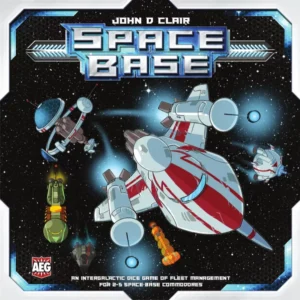
Space Base is a dice-rolling, engine-building board game with lots of cards. The theme is somewhat superfluous, but allows for sleek, readable sci-fi artwork that doesn’t harm the game’s proceedings.
Like many engine-builders, it can be satisfying to build up from meager beginnings to, at the end, watching the whole of your creation snowball into something much more powerful than you might suspect.
Unfortunately, despite some clever design decisions at times, Space Base fails to learn certain lessons that earlier games already solved for, turning them back into issues that hamper the game. In a different context, they wouldn’t be issues at all, but given the style of game Space Base is trying to be, they manifest as problems that keep me from wanting to play this with any regularity.
Space Base – The Premise
You – and all players – have 12 slots corresponding to the results of two six-sided dice that you’ll roll on your turn. Cards slotted into these areas will produce rewards (either resources or abilities) when that die value is rolled, and the more cards you purchase into each area will make these areas more valuable.
There are also two sub-areas, one for your rolls and one for opponent rolls. You’ll often have some minor decision to make (and minor reward) on others’ turns, with the meatier decisions and rewards on your own turn.
Some of you familiar with distribution curves will instantly realize that the juicy 6-7-8 middle is the most likely on two six-sided dice. However, this isn’t entirely true in Space Base.
Dice can be played together or as individual die values, meaning that rolling a 5 and 2 isn’t necessarily 7, but could also be 5 and 2 separately.
The rewards follow suit, with commensurately stronger rewards reserved for the higher numbers. Beyond that, it’s a race to certain endgame conditions. By game’s end, card tableaus are formidable and intimidating, with various chaining effects possible.
The Zen of Simultaneous Play
This isn’t a terribly interactive game (in fact, it’s almost devoid of interaction). However, the designer makes the correct decision to give everyone something to do on most turns.
Opponent rolls can grant you rewards, and you’ll occasionally have small decisions to make in this regard. This is good, because it both gives you a reason to pay attention between your turns, and never gives you overwhelming decisions during someone else’s turn.
Thus, downtime is minimized but play doesn’t drag. If you’re going to make a game that’s mostly everyone in their personal space making decisions that don’t affect the group, downtime can quickly become an issue. Games that account for this and work around it should be commended.
Breaking Down the Math…and Game
I’ve played this game on several occasions with different groups. It’s caught on somewhat in groups I frequent. But notably, I once played it with a group of fellow game designers, and we played four straight sessions of it.
During these games, conversation naturally gravitated toward the game’s structure and the bones of how it was designed. This granular dissection was interesting, but ended up producing a flaw for me.
Basically, we broke down the game’s math to determine that 7 (the most likely result of 2 d6s) wasn’t the most likely in this structure, but rather 6 was. From this, we created a new distribution curve that was a strange permutation of a typical one.
Ok, so 6 is the most likely to appear and thus probably the most valuable, we determined. Then we played a couple more times with this knowledge in-hand. Strategies clearly reflected this. So did outcomes.
A full analysis of balance in the game would involve measuring average rewards of cards as well, so this isn’t to say there’s one “broken” strategy in the game. Though, anecdotally, lots of comments for the game note similar trends in their sessions, with low numbers being favored. I imagine if you optimized your strategy for lots of 5s and 6s appearing, you’d perform quite well.
Some games indeed have imbalances of this nature that aren’t intended by the designer but are nevertheless sussed out by mathematically savvy gamers. I’m not that conceited to imagine I can make this claim with such little rigor, though, and I’m willing to give the designer and publisher the benefit of the doubt in this regard.
However, this touches on a quality of some games that I tend to abhor. There’s good and bad play in most games, but trying to mathematically optimize Marracash is impossible, for instance. Too much depends on the situation, and thus it’s more fluid and emergent in its best practices. It’s also less solvable and thus more replayable.
Interesting as the math analysis was at that particular moment, this isn’t how I find fun in games. In fact, games that are accepting of such analysis tend to be the kind of dry, calculative experiences that I avoid in board games.
Maybe it turns out that 6 isn’t the “best” card number in the game. Or maybe it is. Either way, I found myself annoyed that the game was devoid enough of emergent, interactive properties that we could napkin-math our way to strategic optimization so easily.
Mitigating for Dice Luck
There’s a tired criticism of many games that are “all luck.” I generally disagree with the critique, because unless we want to play Chess (or something similar) luck should be a part of what’s happening. It’s what provides variance, surprise and excitement.
Conversely, there are games where the entire point is to enjoy the unfairness of the dice. These are generally simple party-style games, and rolling with the punches they deliver is part of the fun.
However, context matters. Space Base is a game with lots of dice-rolling luck, but it’s also trying to be an intensely calculative, strategic game. It’s also, more importantly, a game with very little interaction.
Forget math analysis for a second: the single best strategy in Space Base is to have other players roll numbers on their turn that you have lots of cards for in your tableau. If you have that happen, you’re going to do well.
The comparison my designer friends made at one point was to Catan, that ubiquitous herald of modern hobby gaming. And it’s true, there are some similarities. Dice luck can tank your game in Catan as well.
What I believe my friends got wrong is that Catan offers ways to mitigate for this luck in the form of trading. If someone is having horrible luck, I’m more likely to trade with them. And if they’re very lucky, the table should be silently black-balling them out of trades to ensure they don’t run away with the win. This interpersonal dynamic is the balancing mechanism that’s needed for the game to work.
Can luck still dictate outcomes in Catan? Absolutely. But it’s not the end of the story in most instances.
But in Space Base? I can’t do much if my numbers just aren’t coming up. Nor can the rest of the table if one player is getting all the luck. Which can then also create a “rich get richer” issue where they have more cards in their tableau after some early luck, further mitigating the risk of poor luck.
Imagine that 6 really is the “overpowered” card type in Space Base, and somebody gets a couple of them early. But now they have a target on their back and the rest of the table has to collectively pull themselves up to compete via mutual collaboration. Instead, you’ll simply have to hope 6s appear less than is statistically likely. This would be a more defensible game to me, because it wouldn’t rob the strategy from the strategy game.
The game’s defenders might point to certain strategies that mitigate this, and it’s true that savvy play can help. But the perception and possibility remains that you could simply have to watch as others race ahead not due to better play but blind luck, and that you have no strategic recourse for closing this luck gap.
In a shorter game, or sillier one, this wouldn’t be an issue. Rolling with punches and all that. In a more interactive game, it also wouldn’t be an issue. But Space Base is neither of those things.
This was solved for (or at least accounted for) in 1995. We have a precedent for it. So why did Space Base not learn this lesson?
It’s a regression of a design idiom, unfortunately so.
Space Base – Conclusions
There’s a kinetic thrill to rolling dice, and a cognitive one seeing your tableau produce more (and more consistent) rewards. Even if you lose by 25 points, there will be gamers who enjoy this feeling enough to overlook the game’s faults.
To say that I think this one has a lack of replayability, though, is an understatement. The game’s expansions – which I haven’t played, for reference – likely don’t change this opinion. More options within its subsystems would just give us more synergies to suss out, past which I’d hit the same wall.
The lack of interpersonal interaction would (and does) grate on me, and the mismatch of mechanics and genre would (and do) doom my excitement. Even for fans of engine-builders, I sort of wonder why the luck doesn’t grate on them more. Most fans of engine-builders I encounter enjoy the calculative precision in their strategic designs, and the dice-rolling seems at odds with this. In a slightly more interactive context, this luck would be a selling point for me, but then it would also be a different style of game. As it is, there’s a dissonance between these elements that is unresolvable for me, and will be for others like me.
…
Like my content and want more? Check out my other reviews and game musings!
Read More From BTD
Recent Posts
Categories
- All (358)
- Announcements (4)
- Board Games (208)
- DMing (28)
- Game Design (17)
- Playing TTRPGs (22)
- Reviews (195)
- RPGs (142)
- Session Reports (91)
- Why Games Matter (9)