The Best Stefan Dorra Board Games

By MARK WILSON
Stefan Dorra is, to me, the most underrated board game designer I’ve ever encountered. Many gamers I interact with have played a single game he’s designed – For Sale – and no others. For Sale is great, but it’s only one game and just happens to be the one of his that’s reached mainstream appeal, at least here in the US (I understand he’s more well-known in some European gaming markets).
If an impossibly prolific Dr. Knizia didn’t exist, Dorra would also be a shoe-in pick for my favorite designer ever. Dorra is frankly probably the designer I take the most cues from in my own design efforts. His design sensibilities and my play sensibilities overlap to an alarming degree.
Of course, a portion of my audience is deep into the gaming weeds with German designers and have played 10-30 of Dorra’s games, but we’re talking about the norm, not those exceptions. If you’re a typical hobbyist or casual gamer, it’s more than likely that For Sale is your only experience with him.
Which is a shame. So let’s correct that.
What Are Stefan Dorra Games Like?
- They are rules-lite. Most of his games can be played in an hour or less (including teaching), and their strategic or interpersonal depths come from how the streamlined mechanical systems interact with one another via player actions.
- They are interactive. Auctions, negotiation, shared incentives, opportunities for schadenfreude, and more are featured in his games. Very little you do in Dorra’s games will affect no one else at the table.
- They are player driven. This is a subset of item #2 above, but they aren’t identical. Dorra games put a lot of tools in the hands of the players to self-correct in games when either player actions or the buffeting forces of Fate (i.e. luck) hurt one or more players. Even in his games that aren’t explicitly negotiation games, oftentimes outcomes feel implicitly negotiated through players pivoting, scheming and accounting for swings of luck or strategy.
CAVEATS:
- I only include games I’ve actually played. It does not include all that I’ve played, since not every game he’s designed is a winner (just most of them).
- This is my personal list of favorites, not based on sales figures or outside ranks.
HM: Sardegna/Kreta
A medium-weight area control game that allows players to control much of the tempo of the game. The areas that score – and in what order – aren’t precisely known, but just enough information is provided that you can mix short-term tactics with long-term planning. Your hand of cards have different actions, each corresponding to some beneficial action. But you have to determine order and timing, and lose tempo to take the cards back into your hand, which can leave you vulnerable to the tactics of others.
It feels to me like a slightly more interactive version of Concordia, which has a bigger fanbase but perhaps fewer teeth.
10: El Paso
El Paso is a press-your-luck game that extends its mechanics and play time out a touch longer than many in the genre. This risks overstaying its welcome, but also gives the game a chance to breathe, and for narratives to emerge in the whole.
There’s also a real-time card grabbing phase that is wild, chaotic fun, and is the sort of goofy, fun-first decision that I think more games should embrace. He could have stipulated that everyone draw a card in a specific turn order and no one would have argued. Instead, though, he injected a frantic mad-dash into a strategy game that can’t help but produce smiles.
9: Hellas
Ignoring the somewhat generic theming, this is a tile-laying game with some sneaky elements of timing and game flow manipulation that can cause some players to sink or swim.
You’re building elements of a city while gathering stone from the game’s mines to fuel your building efforts. These mines can run dry, though, so proximity to a mine is only a temporary boon, and the timing of them going dry can be dictated in part by players.
Most actions will see all players taking the action, with the active player going first. But maximizing those early actions when you have them can manifest in some significant advantages.
Hellas looks like a fairly standard “points for everything” game until you realize how nearly every action rearranges the game state for every player in some tangible way, but without feeling random or chaotic. Shared incentives create temporary truces in some areas, while other areas (mines, etc.) get unceremoniously trashed to stick it to opponents. If a game’s going to have half a dozen types of points, this is how it should be done.
8: Skull Queen
A hilariously punitive trick-taking game where you’ll end up taking some bad beats (walking the plank) but it will always feel earned.
The game solves elegantly for the problem of certain cards being better or worse by allowing you to adjust the direction of your plank and starting values of your suits. There will be rounds in which you want to lose a lot, and this improves your score. As a result, there’s no such thing as a bad/good/better/worse hand, at least in theory.
Which is the other fun part, since things often won’t go to plan. But it has the feeling of tying your own noose with your decisions, rather than the game buffeting you with random forces. This makes the schadenfreude funnier and the bad beats more palatable. Yes, you got hosed with some bad luck, but also positioned yourself in a way that risked that outcome. The risk/reward of these decisions makes the game delicious.
Dorra actually has two trick-taker games that are more popular than this one and are also probably worth a look – Sluff Off and Nyet – but this one is my favorite.
7: Tonga Bonga
Another family-weight strategy game, this one sees you bribing other players to give you their dice (sailors) by offering juicy rewards for them to crew your ship. But you also have to send your dice off to crew others’ ships.
Pay too much and you’ll fall behind even if you get the best dice (movement is good, as the game is largely – but not entirely – a race). But if you shower a player with the best dice, they may race ahead on points. Helping or hindering others becomes part of the shared negotiation space of the game, but all within a few simple rules.
6: The Bucket King
You, er, have a pyramid of buckets. As one does. But other farmers also have pyramids and you want to knock them down for…reasons? And so you send animals at the other bucket piles?!
Ignore the theme. It’s just there for silliness. This is a “climbing” card game in which making big plays reduces your hand size permanently, but avoiding bigger plays will often equate to a slow death. Thus, it becomes a hand management puzzle where the other players are actively trying to undermine your efforts. It’s funny and fascinating in equal measure.
5: Intrigue
Intrigue is a relatively simple but staggeringly open negotiation game, wherein you win with the most money, but can only get money by having your scholars employed in other players’ estates. Deals must be struck for this to happen.
It’s mean. No, meaner than you’re thinking. At least potentially so.
At its most punitive moments, the game is extremely brutal and creates a lot of zero-sum circumstances and opportunities to pocket some money without reciprocating with a favor. But that also makes cooperation more precious. And tenuous. Hell, you’ll likely even have to work with someone who screwed you over earlier in the game. It requires a short memory, especially when you realize that if you don’t self-balance with deals at the table, the player who hasn’t been hurt all game is going to run away with the win.
Related Reading:
I mentioned that “player-driven” was a quality of Dorra’s games, and no game exemplifies this more than Intrigue.
4: Turn the Tide
A game of hand management and doublethink. I’d call it trick-taking, but really it’s just 30-45 minutes of loss avoidance, and trying to navigate through a hand of cards without taking the wrong “prize.”
Hand of cards from a deck numbered 1-60, simultaneously revealed each turn, with the 2nd highest number taking the highest “tide card” that’s in the center, and the highest number taking the other. That’s it. You do that over and over again. And it’s great.
It once again solves elegantly for draw luck by making every player pass their hand around the table after each round. So in a four-player game, for instance, everyone plays with the same four hands. There are still randomized factors, but it’s player decisions that determine the outcome, not what cards you draw.
It’s extremely funny too. I’ve rarely laughed harder in a game than during my best sessions of this. This requires a willingness to laugh at one’s own bad beats, but if you adopt that mentality, it’s some lovely schadenfreude.
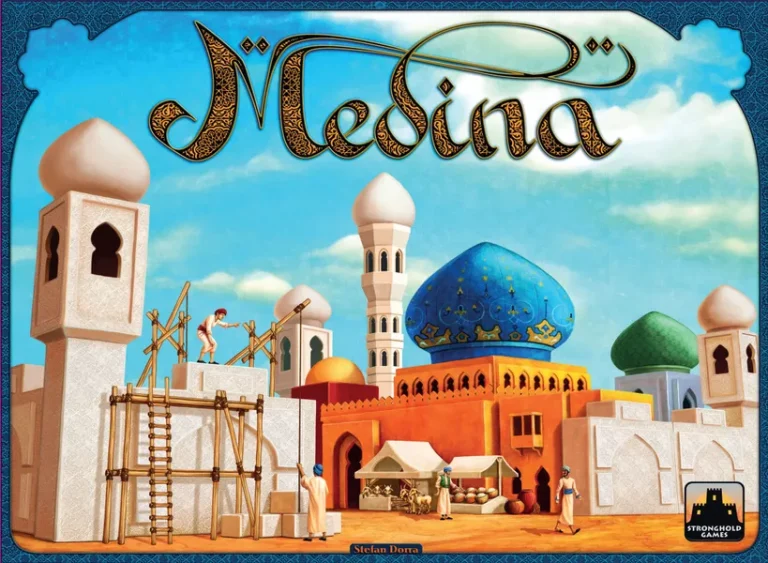
3: Medina
In Medina, you…build the city of Medina. It’s sort of lovely, at least if it wasn’t so passive-aggressive.
ALSO READ: Medina Board Game Review
The literal city-building – which feels tactile even in digital form – is cool, and the freedom throughout most of the game is considerable (that’s a compliment). I initially thought the early game lacked appropriate feedback (any placement seems as good as any other), but the Well micro-expansion that comes with the game’s 2nd edition fixes this amenably. And some of that skepticism was born of a lack of familiarity with the game’s nuance, which takes several plays for even many veteran gamers to absorb.
Some areas of the board will feel like a game of Chicken, and getting an opponent to over-commit somewhere is sometimes just as big a win as capturing a nice area of your own. You can easily give opponents points if you aren’t careful, but can also gain from their actions if you adapt properly.
The late game does occasionally risk turning into a math puzzle as everything begins to shake out and there are only so many placements left to determine. Since it’s a perfect-information game, there’s no getting around this. But careful planning is still rewarded through most phases of the game. Together, the game works quite well, and the variety of both tactical and strategic considerations, and the level to which it asks you to adapt both throughout a game, is impressive.
2: For Sale
Ah, For Sale. It’s timeless and intuitive for nearly any audience. It’s also an auction game that has won over players in my life who normally don’t go in for auctions as a mechanism in their games.
Two phases: bid for housing properties, then bid for payouts with the properties. Timing your bids correctly and shifting your valuations of different properties and payouts based on opponent actions lends the game ample replayability. But it plays smoothly and quickly even at its maximum of six players.
The highest compliment I can give to For Sale is that I can’t think of anything I’d add to or remove from it to make it better. It’s exactly what it needs to be to deliver its gaming experience.
1: Marracash
Marracash is far from Dorra’s most well-known title, though there are rumblings of a reprint that could resurrect it. Until then, it’s one of the most buried gems I know of in board gaming.
You are shop owners in the market of Marrakech, and you can only do two things: purchase shops and usher customers through the city. That’s it. What follows is an entangled web of shared incentives with other players, since the tour guides receive a bonus for showing people into shops they want to purchase from. So the game isn’t just about getting yourself the most points, but setting up the game state so that others are incentivized to help you in little ways to help themselves even more.
Do this enough and you’ll win. Fail to see a clever pivot from another player, or incorrectly gauge their tolerance for mutual benefit, though, and you will be left scrambling. The whole game plays out like a bit of a dance, where players are rarely overtly against anyone else, but all actions come with passive-aggressive undertones and paranoia.
It’s a masterclass in emergent complexities and interactions from a simple design premise, and it’s my favorite Stefan Dorra game and one of my favorite games, period.
__
If I excited you with the descriptions of some of those, I’d encourage you to track some of Dorra’s games down. Some aren’t for the faint of heart, but can be incredibly amusing and interesting if you don’t mind taking some licks. And they’re almost invariably easy to learn and play, while harboring considerable depths as a result of the emergent interactions between players.
And since I write these articles well in advance of them being released on my website, I didn’t even get to talk about a few recent fun discoveries, like Donkey Bridge and Streetcar. And there are undoubtedly more to explore.
Regardless, a new Stefan Dorra game always gets my attention, and I hope I’ve clued you in to some of the best ones he’s designed in his long, prolific career.
…
Like my content and want more? Check out my other reviews and game musings!
Read More From BTD
Recent Posts
Categories
- All (370)
- Announcements (4)
- Board Games (217)
- DMing (29)
- Game Design (21)
- Playing TTRPGs (22)
- Reviews (203)
- RPGs (145)
- Session Reports (92)
- Why Games Matter (13)