Evolution: Climate Board Game Review

By MARK WILSON
Year Published: 2016
Players: 2-6
Playing Time: 60 Minutes
Figuring out how to avoid the evolution puns is going to be the hardest part of this review, particularly since this is a sequel that builds directly off of its predecessor. But let’s give it a shot.
Evolution: Climate is a sequel to Evolution, a game from designer Dominic Crapuchettes. In both, you’re spawning and evolving species of animals, giving them traits, and warring with other species over a limited pool of food that can keep you alive and also facilitate your growth (literal or figurative).
This being a board game, things like number of species you have alive, how much food you’ve eaten, and the number of evolved traits each one has all relate to your final point total.
Adapting to the Landscape
The game has a nastier side as well, and not just because food is often a zero-sum war between species. You can also evolve your species to become carnivorous, siphoning food from the other animals themselves instead of banking on the communal food well.
In turn, you can adapt species to protect against such predators. Or evolve the predators to overcome the adaptations, allowing them to continue to feast on their competition.
And so on. It’s more-or-less like a complicated rock-paper-scissors system of adaptations, except there’s something like 16 possible adaptations, and myriad ways you can mix and match them into something unique and powerful.
Maybe one species eats more than their share, so as long as you can get early enough access to the food trough, you can empty it out before other species get to feed. Another might need less food, or be able to last a while eating its own fat, like a camel might.
In this “Climate” variation of the system, the climate itself is also a factor. Players can slowly nudge the weather one direction or another, until you’re in an ice age or until it’s too swelteringly hot for any but the most well-adapted animals to survive. Your strategy could involve plunging the world into an ice age, for example, while sitting on some fur-growing adaptations that will allow your animals to survive while others wither.
It’s a fluid environment, and like many of the best games it requires savvy adaptations of your strategy at key moments in order to thrive. Species can’t possess an infinite number of traits, so choosing which ones to deploy, and when, is vitally important.
Presentation and Theme
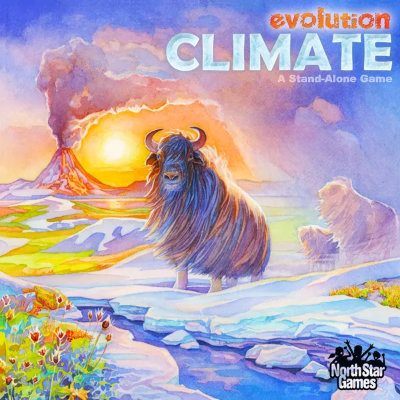
The pastel landscapes and vibrant colors of the artwork all work quite wonderfully. Even the box is something I’d happily frame and hang on my wall, were it turned into a poster or painting. The production values here in general are quite lovely, while also not feeling needlessly overproduced to my eye. Only the too-large starting player token (a wooden dinosaur) seems excessive.
The setting – that of prehistoric life and its struggle for survival – also maps shockingly well to the gameplay. There will be no claims of “pasted on theme” for this, as many games seem to be where the mechanics do not strongly evoke the setting. You feel as though you are clawing for survival in this one.
The Promise of the Premise, and When It Delivers
Unfortunately, I do have to pause my praise for a moment to talk about when the game doesn’t work as well as it can.
The climate track promises game-changing weather realignments that necessitate sweeping changes from all players. But in practice, across several sessions, I have yet to see the extremes of this track. It’s obviously possible, but given that rarely will all players want to move the climate track in the same direction, in most sessions the climate will hover around the middle for most or all of the game, with the players who have viable moderate-climate species mitigating the maniac who’s, say, hoarding furs and wants to freeze everyone to death.
It’s here that the game’s potential for amazing drama instead feels anticlimactic. Anti-climate-ic? Sorry, but there’s the one pun I’ll use.
I also described something akin to a dance above in terms of how you’ll adapt to opponents, then they’ll adapt to you, and so on. And in the best sessions, this is exactly what happens.
Other times, though, the food might be plentiful enough that it’s just a race for efficiency, or your card draws necessitate a particular strategy. In my best sessions, I’ve felt intimately connected to other players and their strategies, and we’re undercutting each other just as much as helping ourselves. In the least tense sessions, though, there’s too much happening to involve ourselves this closely, and the game is just an excuse to see who builds the best food-eating engine.
For this reason, I’d actually recommend it wholeheartedly at 3-4 players, but not necessarily at 5-6 players. This is unfortunate, because the game’s length doesn’t drag much at higher player counts. It’s a remarkably streamlined design in this sense, with a lot of simultaneous play, but without sacrificing interaction between players.
But you can’t react to other players as much, because there’s too much to react to at 5-6P. Instead, this forces your attention to your own species. The game becomes more myopic, less furiously contentious, and less evocative of the theme.
Evolution: Climate, Conclusions
This game sits on the edge of ownership for me. I owned it, then sold it to a friend, but have borrowed it back from that friend on two occasions because I got the itch to play it.
If I could consistently play it at 3-4 players, with those who adopt its sneakily cutthroat gameplay, or if I didn’t have regular access to it via my friend’s collection, I might buy it again.
It’s a great system for play, and has much to recommend it that I struggle to find in other titles. But it’s also disjointed enough at times that not owning it has been the correct decision. It’s one I continue to appreciate and enjoy, but is just off the heights of the most consistent favorites for me.
…
For more content, or just to chat, find me on Twitter @BTDungeons, or check out my other reviews and game musings!
Share
Recent Posts
Categories
- All (356)
- Announcements (4)
- Board Games (207)
- DMing (28)
- Game Design (17)
- Playing TTRPGs (22)
- Reviews (193)
- RPGs (142)
- Session Reports (91)
- Why Games Matter (9)