Kill Shakespeare Board Game Review

By MARK WILSON
Year Published: 2014
Players: 2-4
Playing Time: 120-180 Minutes
This game is a lot. Unpacking it is going to take time.
I promise to try my best to make it worth your time, though. And I think it could be.
Why? Because Kill Shakespeare is one of the more unique games I’ve ever reviewed or played. It’s also one that is – in some ways – the worst of its type, and in other ways it’s among the best.
It’s not one thing that can be neatly summarized, and it’s not for most people. In fact, despite owning and enjoying the game, I’m not going to recommend it to anyone except for the most masochistic among you who believe you can put in the work to get the most out of this game.
Intrigued? Buckle up, I guess.
In addition to the normal review stuff, we’re going to cover some basics of theme and gameplay, since this isn’t a well-known game. And I’m also going to walk you through how to learn this game (not a how-to-play, but a step-by-step approach to learning it).
But let’s first start with the theme, because it will set the stage appropriately for just how ridiculous this game’s existence is.
Kill Shakespeare: the Thematic Premise
All of Shakespeare’s creations reside on a massive continent that’s sort of the inverse of the UK. They are self-aware about their existence as creations of The Bard, and Shakespeare himself is a poet-god who resides among them.
Shakespeare is able to do this through the power of his reality-altering, magical quill.
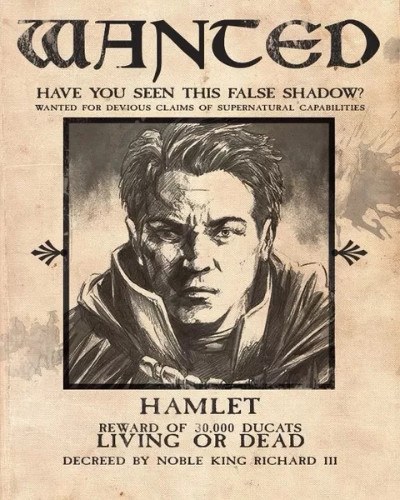
The combined nefarious forces of Richard III and Lady MacBeth have conquered the land. You play as members of the rebellion, led by Hamlet, Juliet, Othello and others.
Richard and Lady McB are on the hunt for Shakespeare, because with his quill, they could rewrite reality to suit their whims. Thus, the title “Kill Shakespeare.”
Within the game, which is semi-cooperative, you win and lose vs. the bad guys together, which necessitates cooperation. But you also want the quill for yourself, which is represented by a victory point track. If you don’t work together, you’ll lose, but you’ll also want to keep this competition in mind, since there will be one “super-winner” of sorts if you manage to thwart the villains.
Pretty insane stuff, right? I’m not even sure I’m doing it justice. It reads like some sort of fever dream of a Shakespearean scholar who took ALL the drugs.
For clarity, this wasn’t all cooked up for the game. It’s based on a comic book series of the same name. I think some copies of the game even come with the first issue of the comic as a reference point.
Though I might not ultimately recommend the game to many people, I can heartily recommend the comic to anyone who thought that description above sounded cool.
Kill Shakespeare: The Gameplay
In practice, Kill Shakespeare plays like a quest-fulfillment adventure game with a series of bidding phases preceding an action phase.
You bid with tokens equaling 30, which stand for days. Each of the game’s six rounds represents one month, so you’re bidding with time, so to speak, that you’re allotting to various tasks.
Stopping the villains’ schemes, saving up energy for long journeys, bidding for various resources (troops, information, etc.) that will be used to complete quests, and so on.
In the action phase, you’ll be moving around the land, combatting enemy forces, gaining influence and completing quests that further your goals.
During this action phase, some quests require cooperation, and you can also trade resources between players. Other moments, like stopping the random bad event that will be drawn each round, require similar coordination between players.
There are a few different ways you can lose the game, each related to the game’s subsystems, so you have to balance each with the realization that you’ll eventually want to be less helpful and more selfish.
I’m glossing over a lot in that description, and we’ll talk more about its complexity in just a moment. But that’s the general flow of gameplay.
Production and Rules Woes – i.e. Why You’ve Never Heard of This Game
The rulebook is unreadably bad. Seriously, it’s incomplete, incorrect at several points, and is generally one of the worst rulebooks in all of gaming.
To add insult to injury, the game is quite complicated. You’re not going to be able to house-rule your way to something coherent after reading the rulebook, hoping to patch up the rough edges. It’s too far gone for that.
The production is also sub-par. Some aspects, like the central board and card art, are perfectly fine and even quite cool. A picture of the totality of the thing will look impressive to some.
The devil is in the details though. Player chits – which were obviously supposed to be cubes before production cuts happened – are often so miserably colored that you can’t distinguish one player’s chits from another on the board.
I had to replace these with regular cubes that I bought separately. I also bought little castle standees for the game’s fortresses, which are simply represented by images on the board and can easily be accidentally covered.
Other chips and smaller pieces were cut weirdly, or have off-center text, or occasionally text that’s printed backward (?!). It’s baffling. I’ve never seen such a lack of quality control on a production that obviously took quite a bit of effort.
Other minor gripes abound, though these are the largest. In all, it paints the picture of a game that received no quality control love.
As a result, the game was dead on arrival after it was funded and shipped back in 2014.
How to Learn Kill Shakespeare
Good news, though! A couple dedicated fans, aided by one of the designers himself (who is apologetic and heartbroken about the game’s production to this day, over a decade later), have made the game playable.
But it’s still not easy.
Here’s my recommendation for how you should go about learning this game:
- Watch Connect More’s (David’s) how-to-play video.
- Watch Rahdo’s playthrough videos (Part I Here – Part II Here).
- Download Rahdo’s revised rulebook.
- Download Connect More’s player aids.
- Read through the new rulebook and player aids, and chuck the original rulebook into your garbage.
If that sounds like a lot, it is. If it sounds like more work than you should have to put in to learn a game, you’re right.
The good news, though, is that the game is actually quite coherent…once it’s properly explained and laid out in the rules. I won’t call it simple. It’s not. But it’s something that can be assessed as a plaything rather than simply lamenting its lack of playability out of the box.
Where (and With Whom) You Shouldn’t Play This Game
The other thing this game is, is long. The box says it will take you 2-3 hours. This is optimistic in my experience.
Oh, you could definitely play this in under three hours in a technical sense, assuming you aren’t teaching to anyone, and you’re ignoring the somewhat considerable setup and teardown time. But even then, I suspect that you’d only keep it to perhaps 120 minutes of actual playtime if you limited the table talk and more meticulous planning that make up some of the game’s more interesting moments.
As I’ll talk about in a moment, this isn’t necessarily a problem. But it does limit the use-cases for the game.
- I’ll never take this to a public meetup.
- I’ll never play it when we have less than 4-5 hours to set up, teach/refresh, play and tear down.
- I’ll never play this with anyone who hasn’t agreed to play beforehand, and knows what type of experience it’s going to be.
Where (and With Whom) to Play With
So where (and with whom) should you play the game?
I’ve found that it works well as a two-player game that I can set up the day before in my home, play with my significant other (we’re both gamers and Shakespeare fans), and tear down after she’s left. We spend a quiet afternoon or evening together playing.
And it works really well. So let’s use this as the transition point for this article, because I now want to talk about why I kinda-sorta love Kill Shakespeare.
What’s Great About the Game?
Kill Shakespeare is a thematic, narrative experience. Any positive statement for the game has to include this fact, since it’s among the core appeals on any level.
I adore the theme and the comic series that it’s based on, and this was why I held onto the game for nearly a decade before finally getting to play it. But I realized what I was asking of someone else to play it with me, so I didn’t bring it to public meetups and such. It would have failed catastrophically in this environment.
Instead, my partner and I got to watch the drama unfold from the comfort of my home, and sink into the dramatic, thematic elements of the plot.
The quest cards even have little story arcs on them that play out in three Acts, mapping to fictional events of the comics. It’s neat.
However, theme is brought to life through gameplay, not card text. How does Kill Shakesepare do this?
First, there’s ample game-to-player tension. You’ll have tough decisions and difficult quests very shortly into the game. Get lucky with card and event draws and this may be a touch easier, but you can never let your foot off the gas, so to speak, and even in the most fortuitous sessions will likely be defending against the game’s loss conditions into the game’s final round. This is good.
Even better, the opportunities for table talk are myriad. You’ll be conversing constantly to coordinate and muse on possible actions.
And while you can suggest courses of action for other players, the game circumvents the dreaded “quarterbacking” problem in cooperative games in two major ways:
- There’s rarely one “best” course of action in a round.
- There are valid reasons that players may want different outcomes to an event or auction or sequence of events in an action phase. Sussing out “best” play isn’t as simple as doing a logic puzzle to find efficiencies
The semi-cooperative nature also means that you can, for example, seriously consider letting one of the game’s bad events occur without a rebuttal, if you think that you can collectively weather whatever bad thing will happen, and you may be able to put your resources to better use elsewhere. Meanwhile, depending on the situation, another player may be highly incentivized to stop the event, which then opens up the negotiation space of the game a bit (since it’s always easier to stop the events with some help).
This is indicative of other examples I could name, but they all broadly speak to the nuance in the game’s system.
So there are layers to the interaction, creating player-to-player drama and tensions as well.
The game plays fairly intuitively once grokked, despite the length. So you’re thrust into these thematic and interpersonal tensions as soon as you absorb the basics of the system. You’ll still need to have a revised ruleset with a round’s sequence of events handy, to make sure you don’t skip something. But that won’t meaningfully distract from the narrative unfolding through play.
Kill Shakespeare: Conclusions
Do I recommend this game? Hell no. But I told you that would be the case at the start.
Kill Shakespeare is an anomaly, a curiosity. It’s too wildly different not to talk about in a review of this length.
But it’s also probably a game you never need to own or play. Other great narratively-driven adventure games exist on the market, ones that will be easier to get to the table and don’t require all of the upfront work of Kill Shakespeare in order to truly enjoy them. They’re not as long, not as hard to learn, and equally as evocative of their subject matter.
If that conclusion seems odd, given that I own and enjoy it, it’s because I’m also writing this for that edge-case gamer, who has read everything here and realizes what it would mean to own Kill Shakespeare. For me, it was almost 10 years of ownership before I finally played it. And it easily could have been another 10 if I hadn’t found the right situation for it.
They know that and they’re still intrigued. And they’re willing to put in some work to make the experience smoother. And they have the right environment or play partner to be able to get the most out of the game. And the theme seems deliriously interesting to them.
This game could still be for that person, as it is for me. I don’t expect to play more than 1-2 times per year, and only in specific situations. But for some games, those that justify themselves as a memorable event every time you play them, that’s enough.
_______________________
For more content, check out my other reviews and game musings!
Share
Recent Posts
Categories
- All (357)
- Announcements (4)
- Board Games (207)
- DMing (28)
- Game Design (17)
- Playing TTRPGs (22)
- Reviews (194)
- RPGs (142)
- Session Reports (91)
- Why Games Matter (9)