Witch's Brew Board Game Review

By MARK WILSON
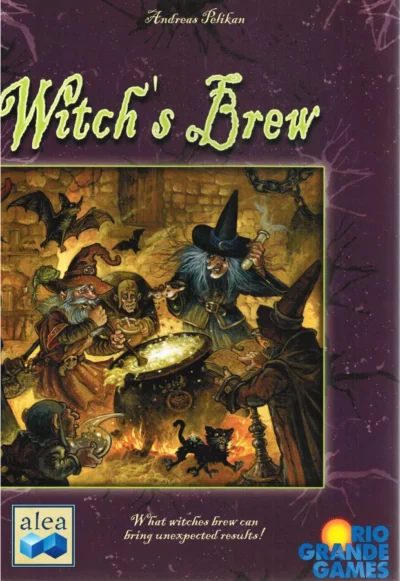
Game: Witch’s Brew
Released: 2008
Players: 3-5
There are two games in this review. Ostensibly, it’s a review of Witch’s Brew, a board game from Andreas Pelikan that came out in 2008.
It’s also a stealthy review of the sequel to Witch’s Brew, a game called Broom Service. This latter game is much more heralded, both in the awards it has won and in general notoriety. If I cared about this review ranking better in search engines, I’d lead with Broom Service.
I suppose this plays into my predilection for covering the more obscure bauble, given two options, but a lot of what I’m about to say applies to both games. I’ll give some lip service to differences below, but it’s almost true to call Broom Service a reimplementation of Witch’s Brew. Almost.
We’ll get to that, though.
Witch’s Brew: The Gameplay
You play as one of the titular witches, and you’re, well, brewing potions and such. You want points, naturally.
The game is one of doublethink. Every player has the same dozen actions that correspond to things like collecting certain types of resources, converting those resources into roiling cauldrons of points, a few other minor conversions, and spells that allow you to jump the queue on certain actions. So far, so standard.
Each action, though, has a more powerful ability and a less powerful one. You can always take the less powerful one for a guaranteed payout. Or…you can opt for the more powerful option (by declaring yourself the True Wolf Keeper, or whatever other role the action corresponds to). But you risk subsequent players overwriting your claim with their own, leaving you with nothing as a reward.
Each player only gets to choose five actions in a round, so you could get lucky and overlap with no one. Or each of your chosen actions could be lurking in others’ hands as well, just waiting to usurp you, giving you nothing.
This brave/cowardly dance is at the heart of gameplay.
Flexibility and Doublethink
If you start a particular action, you have to take the “brave” (top, more powerful) action. Then anyone else in turn has to make a choice: brave or cowardly?
Starting an action thus means you’ll often get nothing for it, though at any player count, this isn’t always true. Savvy role selection can help you time actions so that you’re the only one at the table who has selected it this round.
If you’re the last to play in this wheel of paranoia, your brave action is guaranteed to go through. But then that means you have to start the next action. Even here, players will occasionally choose the cowardly option, simply to make someone else play first in the next bout.
Turn order is massive in the game, as you might suspect. And the examples I gave just above should start to give you a sense of how nuanced the gameplay can become in regard to manipulating turn order.
What is powerful enough to convince a competitive gamer to take the lesser of two options? In this game, it’s the knowledge that, for example, they’ll play fourth on the next action instead of first.
Other times, though, you’ll throw caution to the wind, either not minding if your next action doesn’t go through, or suspecting that you might be able to sneak one through.
It’s this shifting dynamic that gives the game a lot of its power. The other players – their plans and mindsets – need to be part of your strategy. But so too does your immediate game state, since the race for resources, potions and other avenues of points go quickly.
Striking a Balance, Finding a Flow
I tend to enjoy games that mix the tactical, lightly strategic, and psychological. Witch’s Brew does that amenably, and so I’m quite glowing on it in general.
It’s possible, of course, to be on the short end of the doublethink stick a few too many times, to the point where you’re playing for pride instead of any chance at a win late in the game. Oh, sure, in theory you could get a rush of good luck as well and make a comeback. This is certainly possible, though not always probable. Lady Luck will shine on some more than others.
This isn’t only justified by the game, though, it’s what draws many people to the game in the first place!
The other item to assuage your fears is how quickly this one tends to play for me. I do prefer it at its higher player counts, but even here it’s never gone over its 60 minute stated length, and often it’s more like 45. For the emergent narrative the game delivers, and the emotional throughput of its gameplay that gives it a majesty not suggested by its rather quaint components, 45 minutes feels like a summer breeze wafting over me. Stated less poetically, it doesn’t overstay its welcome.
Broom Service: Adding a Sense of Place
Broom Service is…much the same, but it adds a map since you’re delivering potions now!
I’ve seen some rather pointed opinions favoring one over the other, but to my eye the appeals of both overlap considerably. Which is not to say they lack differences! Here are a handful:
- The theme, which seems like an attempt to emulate Kiki’s Delivery Service while remaining legally distinct, makes Broom Service the easier sell for many audiences who value thematic elements.
- The board gives it a table presence that may similarly entice those who want to feel as though they’re playing something with a sense of place.
- The board is a bit muddy from a UX (user experience) perspective; I’ve never had a session where someone didn’t get confused at least once about what it does and doesn’t allow in terms of movement.
- Conversely, with fewer components, Witch’s Brew takes up less shelf space and table space.
- The furthest corners of the board can be hard to reach, or not worth the actions you’ll need to devote to getting there. And so some sessions will feel as though you only used about half of the play area.
- Broom Service features only four actions per round (instead of WB’s five), but doesn’t require that the starting player for each choose the brave option. Whether or not you see this as more or less restrictive, more or less flexible, is a matter of taste.
Which I recommend is probably more related to which you can more easily find. As I write this, neither is readily available except on the secondary market. Shocking, given Broom Service’s pedigree as a Kennerspiel des Jahres winner! I have to assume it will see a reprinting at some point, even if Witch’s Brew is left to languish. A shame, since both are excellent games.
Witch’s Brew: Conclusions
Witch’s Brew could be called a one-trick pony, and I wouldn’t object. The round structure will never deviate.
It’s a good trick though, one that harbors a lot of variance despite the straightforward gameplay.
My favorite games tend to mix the tactical with the interpersonal. Smirking at a player as you overwrite their action and they groan, only to have the same done to you seconds later, is the stuff tabletop legends are made of.
Reversals, good and bad fortune alike all elicit strong reactions from players at the table, and due to the nature of gameplay, it feels playful rather than personal (though ideally in the company of good friends or family, it’s a bit of both).
That it does this with a manageable teaching time and play time, and some baked-in replayability due to how player personalities will interact over time, make Witch’s Brew a game I can easily endorse.
…
Like my content and want more? Check out my other reviews and game musings!
Read More From BTD
Recent Posts
Categories
- All (371)
- Announcements (4)
- Board Games (218)
- DMing (29)
- Game Design (21)
- Playing TTRPGs (22)
- Reviews (204)
- RPGs (145)
- Session Reports (92)
- Why Games Matter (13)