Xe Queo! (aka Der Isses) Board Game Review

By MARK WILSON
Year Published: 1998
Players: 2 (2-4 players in its Museum Heist reedition)
Playing Time: 20 minutes
Xe Queo!, which in some editions goes by the name Der Isses!, is a game from Alex Randolph, released in 1998. It plays extremely quickly and holds two players. It’s most succinctly described as an abstract game with psychological, doublethink elements.
This also acts as a review of its pseudo-sequel, Museum Heist, which was released after Randolph’s death. Museum Heist has the same core structure, but holds up to four players. I’ll note differences further down.
Randolph is something of a legend in game design. He was one of the earliest commercial designers to receive international acclaim, and he’s cited as an inspiration by a lot of designers that rose to prominence in the 90s and 2000s and informed a lot of what we consider to be hobby games even today.
Randolph’s games don’t necessarily resemble these more modern games, though. I saw a review once that called many of his games “one-dimensional.” And I think this is a good way to think about them.
Not one-dimensional in the sense that they lack depth or nuance. But his games often explore a single mechanical idea. This makes them focused, but perhaps narrow in their potential audience.
Xe Queo is an excellent example of this. It’s extremely singular in its focus, but it means that if you don’t like the thing that it delivers, there’s nothing for you here.
There’s power in such focus, though. It allows a design to elicit the most of its core tensions and finds levels of nuance within the simple structure that additional mechanics would likely bury.
I also adore Xe Queo, to get that out of the way. This review should help explain why, and also give you a sense of whether or not you’ll feel similarly.
Xe Queo – Gameplay
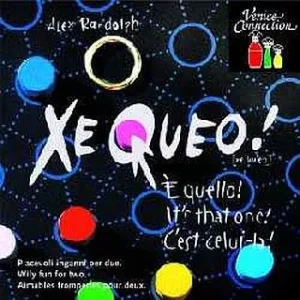
7×7 grid of circular spaces, linked by lines both orthogonally and diagonally. Seven pieces of varying colors arranged at random in the spaces. And a ring that acts as sort of a gravity well, pulling pieces in.
You choose a color secretly that is yours for the round, as does your opponent.
On your turn you move a single piece one space. It has to move closer to the ring. You can do Checkers-style jumps of the other pieces to move further at various moments. If you move your color into the ring, you win the round.
Unless your opponent was also that color. Then they win.
You can, instead of moving, guess your opponent’s color. If you’re right, you win the round. If you’re not, you lose.
I think I just taught you the whole game. So how is this simple nonsense in the top 50 or so out of roughly 1,000 games I’ve played in my lifetime?
Layers of Doublethink
I’ll be honest, that description doesn’t sound too exciting even to me. Maybe I have my work cut out for me to sell this thing.
If it helps, it’s one of the easier games ever to proxy with generic components, so you could mock up a copy and see for yourself. But let’s get back to gameplay.
The first time we played, my girlfriend picked a color quite far from the ring and mapped out a rough strategy. Me? I moved a color next to the ring immediately. If it was my color, I could end the round on my next turn.
Then it was back to her, and she realized exactly how immediate this game is. Should she call me out? Was I bluffing? Or double-bluffing and hoping to move it into the ring on my next turn?
The shocking rapidity with which we were thrust into the battle of wits can’t be understated.
Now, you might be thinking that this is essentially a coin flip, and you’re likely not wrong. However, that doesn’t detract from the intensity of the moment.
Further, that’s the game at its most arbitrary, though perhaps its most paranoid. At other times it will slow down into something more akin to a slow, tactical dance, where you’re hoping to glean enough information to whittle down deductive options or sneak into a win somehow, or perhaps goad your opponent into an incorrect guess over time.
Because that coin flip I mentioned earlier? It isn’t, actually. There are six other colors besides the one next to the ring. Which makes that guess seem a whole lot more sketchy, doesn’t it? So there’s an incentive to move your own color into the ring instead of being forced to guess your opponent.
But then you can’t always be obvious about it or you’ll be called out too easily…
So then you need to take a more circumspect route to the ring, or try to get your opponent to accidentally help you move it closer…
But then sometimes movements won’t go as you plan and you’d have to be extremely obvious about moving your color, so you have to default to deducing your opponent instead to have a chance at winning a round…
And the cycle continues. Hopefully you can see how an ongoing, emergent narrative can occur between players, one that spans numerous sessions and never produces a single, clear winner or winning strategy.
The Deductive Balance
I was introduced to this game around the same time as another quick bluffing game. It’s fun too, but it’s hard to hide the fact that outcomes and guesses are extremely random. Indeed, in that one you could pick and guess at random and undoubtedly do just as well as someone trying to strategize.
Is the same true of Xe Queo? I don’t think so.
The problem is that any answer to the question is unfalsifiable. Did you actually deduce your opponent’s color in that round, or are you just remembering the successes and not the failures, and thus the fact that it’s somewhat random?
Chance plays a role, make no mistake. And you’ll rarely have anything resembling certainty in your opinion.
But I’ve had a bead on my opponents’ strategies and colors enough times to believe there’s something more here. It’s subtle, extremely so. But it’s here. It’s in learning when a player makes a certain type of move, and why. It’s body language and facial ticks and what happened the round before or the game before.
It’s when they’re making moves trying to trick you but you intuit that it’s because their color won’t make it to the ring this round and they’re trying to buy time to make an inference about your color. Maybe you don’t know their color, but you use these instincts to lead them to make the wrong guess about yours.
It’s when you move a color that you suspect is theirs and, surprised at the unexpected help, they make a non-sequitur of a move in the hopes that you continue furthering their plans, when in fact they just solidified your hunch.
It feels like this deductive opportunity is all here. Can I prove it is? No. But that feeling is enough to draw me in and keep my attention and excitement. When you believe it truly is a battle of wits, and the gameplay rewards this belief, the levels of intrigue become incalculable.
Museum Heist: Expanding the Premise
Everything above is also true of Museum Heist. It adds a few new rules in the form of a larger board, some “trap doors” that allow for faster movement between areas of the board, and a twice-per-game ability to swap the places of two pieces, which in this one represent potential robbers trying to make off with the titular museum’s loot.
I don’t know that the game needs a theme, but I can understand why they added one. Xe Queo doesn’t hide that it’s entirely abstract and isn’t hindered by this fact, but the museum theming works well enough with the mechanics.
Everything good I just said about Xe Queo applies to Museum Heist, but to a slightly lesser extent.
There’s no specific mechanical reason I can point to for this slight lowering of my estimation. It’s more about the interpersonal nature of the game.
Xe Queo feels intimate in its proceedings. I’m not playing a board game, I’m directly playing the other human being, like the lifelong Poker player who’s just reading the other players at the table and barely looking at their cards. The payoff is sweeter when the game is played like this, soul-to-soul, and the agony is more deliciously biting.
In expanding this even to three players, let alone four, a little of this magic is diluted. The core tensions of the game remain intact, make no mistake. But it recedes from something timeless and transcendent into the realm of merely good board games. Those I’ve introduced to Museum Heist see it as an amusing novelty. Those I’ve introduced Xe Queo to, however, tend to have more pronounced reactions, even if they aren’t as praising of it as I am. It affects them more deeply, even if it elicits a mixed reaction in them.
Xe Queo – Conclusions
When a round could legitimately be over in two turns, but will still be infused with absurd amounts of intensity, something special is at work.
Conversely, don’t like trying to read other people? Do you prefer crunching through mathematical or spatial puzzles instead of human ones? You wouldn’t be alone. And if not, Xe Queo will likely feel like a random, pointless game to you, or at least one that’s not a lot of fun.
The austerity and singular focus that draws me to it will repel others if the same qualities are not ones they enjoy in their gaming. For a game that is so specific in its appeals, this is to be expected.
But to me, Xe Queo feels like it should be from 1898 instead of 1998, or perhaps passed down through oral tradition for centuries in some cultures. There’s something primordially simple here that gives it a timeless quality. There are other “what color/faction/character/etc. are the other players?” deductive games in existence, and some of them even predate Xe Queo. I also enjoy a handful of them. It’s a mechanical conceit that can carry a lot of excellent games.
Xe Queo is my favorite of them, though. It embraces the minimalism of its premise to evoke the absolute most out of the moments of drama it creates.
…
Like my content and want more? Check out my other reviews and game musings!
Read More From BTD
Recent Posts
Categories
- All (356)
- Announcements (4)
- Board Games (207)
- DMing (28)
- Game Design (17)
- Playing TTRPGs (22)
- Reviews (193)
- RPGs (142)
- Session Reports (91)
- Why Games Matter (9)