21 Hand Games Review

By MARK WILSON
Year Published: 2024
Players: 2-10
Playing Time: 10 minutes
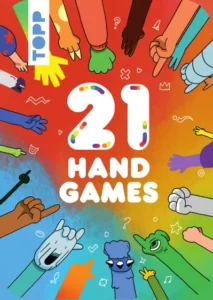
21 Hand Games is, somewhat tautologically, not one game. I might even call it a game system.
The line between a game system and a collection of games is blurry, of course. But there exists several collections of games I’d refer to as systems, because they share various commonalities in components and characteristics.
The best game systems feature a mix of creative innovation and focus on a specific type of experience. Pairs, for instance, is a game but it’s also a deck-system of cards, but not a traditional deck of cards. Its games are numerous and many of them are lots of fun. And while there’s a lot of variation in the games, I’d argue that they form a bit of an experiential bubble that defines the type of games that will work best within its deck-system.
This is not a bad thing. Focus gives power, and trying to be too expansive in the types of games your system can create can, paradoxically, make your system mediocre at any type.
For that matter, a traditional deck of cards probably would have been an even better example, but I already wrote the Pairs stuff, and feel like leaving it.
I’ll get out of the abstract here in a moment, though, to actually talk about the games in this particular collection.
The Value of Playfulness
I enjoy playful thinking, in the childlike sense. I think we need more of it as a society, and most individuals do as well.
21 Hand Games is, if anything, playful.
When I introduce some of its games to friends or family, a lot of people are quick to say things like “Oh, this would be great for the kids…” referring to various younger relations who are at a so-called appropriate age for such silliness.
I believe this is a bit of a subconscious defense mechanism, though, because it’s very hard for us to admit that it’s also great for us as adults. You need not be a child, nor playing with children, to enjoy childlike play.
The collection makes for a great children’s gift, yes, and one to introduce to kids. But this limits its potential.
Hands as Components
The other lovely thing is that you only need people to play these games. Your hands act as point counters, or ways to remember your choices. Nothing else is needed, not even the book once you’ve learned the games (most of which are quite simple).
It opens up the play space considerably; and I mean “space” literally.
On a long car ride? If you aren’t the driver, play some hand games instead of scrolling your phones. In a long line at the bank? Play a game with your partner instead of scrolling your phones (really, we’re just glued to our phones too much, is my other point here).
Or a picnic. Or over drinks at a pub. It’s convenience incarnate, and there’s value in that.
Quality or Quantity
One of the criticisms that can follow game systems or game collections around is that they are good at producing a ton of marginally interesting games, but don’t do any particular thing extremely well.
Why play six mediocre games when you play one really great game instead? So if your collection is all merely ok, not great, why bother with it?
And this can be a valid criticism. I could name names with at least one system I’ve encountered (Piecepack, for those curious, which won’t be getting a full review on this site), and others to a lesser extent.
Does 21 Hand Games pass this test?
Mostly. I can’t claim to have played all 21 games, but I’ve canvassed it enough that I’m happy to report back on some general trends. While many of its games are good-not-great, I do think there are some absolute winners that utilize the format quite well. And on the rest, the lack of logistical overhead in playing them really does elevate its profile to where I am happy to know the games.
Anatomy of a Hand Game
A lot of the games revolve around throwing numbers out and watching them interact in various ways. Since your hands can only “count” so high, a handful of these do seem overly sameish to me. You’ll find one or two you prefer and will probably never return to the rest.
Mind you, some of these are still quite good. There’s one that’s basically a streamlined version of Liar’s Dice. And while I enjoy Liar’s Dice, I might actually prefer the hand version, which doesn’t require a bunch of dice and doesn’t generate the considerable volume of that one’s often noisy cups.
The dexterity ones push in a different direction, and lean into the strengths of the format a bit more. There’s one where players play imaginary ping-pong with three different areas of the (invisible) table to navigate. And another – a favorite of my partner and I – involving a blind “wrist war” in which you’re trying to grapple the others’ wrist with one arm behind the others’ back. It’s 15-30 seconds of giggling, flailing fun, and it lacks the potential for hurts fingers that its older cousin – Thumb War – has produced for me more than once.
Yet another is a cooperative game involving clapping. It’s blindingly simple, but is a unique experience compared to anything that could be created with more traditional gaming components. Again, it’s using the format (hands) to great effect.
Others are more tenuous. River Sub is a one-vs-many hidden movement game. Like most of the others, it’s over in about five minutes, and is reasonable fun. It mirrors some longer games I’ve played and won’t compete with them in experiential excitement, but it works. However, one’s hands in this one are merely to keep track of where your submarine is, and it only goes to 10. So long as you trusted the player, hands are superfluous; the whole thing could be tracked in your head. It’s here that the thematic link to hand games is less strong, even if the game still works amenably.
My favorite – called Mirror Shield – could rightly be called a rock/paper/scissors variant, but with up to eight people (really, it could hold any number, though it would be unwieldy past a certain point). In a legally distinct Harry Potter-esque scenario, you engage in a wizard battle with other players.
It’s brilliant because everyone instantly recognizes the broad format (rock/paper/scissors), but it’s been transported into a legitimately thematic and cinematic environment, and tweaked to work well at multiple player counts.
It kills in any group I’ve introduced it to, usually coming down to a 1-v-1 showdown that everyone else (the eliminated players) are still invested in.
21 Hand Games: Conclusions
Will I still be playing these games in five years, or is this a gimmick fad that merely seems neat until the lustre wears off?
I try to sit with my games for a bit before releasing these reviews; these aren’t chasing the latest releases. And so I can confidently say the games have stuck around.
Some of them, at least. I mentioned a few above, but left out others I frankly don’t enjoy much, or which are just awkward or derivative enough that I never felt compelled to try them simply for the sake of this review.
They’re not all winners. But they don’t need to be. If enough are, that can justify the whole. And so it is here. If I’m only playing 2-3 of them into the future, that’s still a win in my book, since it means those are continuing to provide joy for me and those I play with.
What’s more, the entirety of the endeavor remains exciting to me because of what it represents. Designer Don Eskridge has tapped into his inner child and produced something wonderfully indicative of what I want to see more of in gaming spaces. In providing a template for creating games near the back of the book, he’s even encouraging readers to design their own hand games. What better way to spark the imagination of a fledgling designer, be they 10 years old or 50?
It’s an invitation to come and play, and it’s one I happily accept.
…
Like my content and want more? Check out my other reviews and game musings!
Read More From BTD
Recent Posts
Categories
- All (370)
- Announcements (4)
- Board Games (217)
- DMing (29)
- Game Design (21)
- Playing TTRPGs (22)
- Reviews (203)
- RPGs (145)
- Session Reports (92)
- Why Games Matter (13)