Plantagenet: Cousins' War for England, Board Game Review

By MARK WILSON
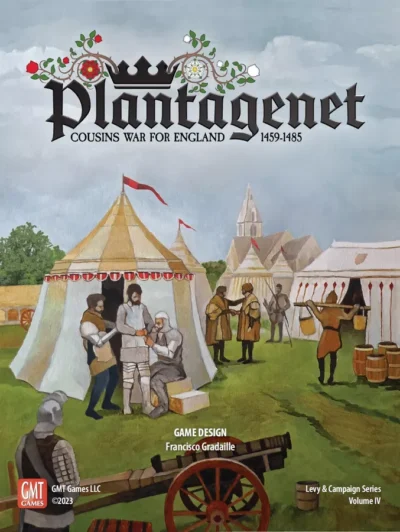
Game: Plantagenet: Cousins’ War for England, 1459-1485
Released: 2023
Players: 1-2
Wargames are different. Plantagenet: Cousins’ War for England is case-in-point to this effect.
I want to set expectations though: more than any review I’ve ever written, this review shouldn’t be read as “is the game good or bad?” My experience with it defies such categorization. Rather, what it is, to whom, and what it says about its subject matter and design ethos (and how that will speak more to some gamers than others), are the more interesting questions to me.
Plantagenet is fascinating as an exploration of history and as a plaything. I’m not sure it’s trying to make a bold statement about its subject, The Wars of the Roses. Rather, it’s trying to provide a sandbox for players to make their own statements while also providing a dense, strategically satisfying game experience. It mostly succeeds at both in my view, but in some ways that I don’t particularly crave in my gaming. And so much of this review will be contextualizing its appeals.
Levy & Campaign
Plantagenet sits within a very loose series of games known as Levy & Campaign games. As you might infer, this refers to the two main phases of the games.
During the levy turn, you’ll do a bunch of preparation. This could include lobbying local lords to your cause, building ships, rallying troops, and other items of infrastructure. These actions generally deplete your lord’s host city and often require a dice roll to complete successfully.
You may also need food to feed your troops, or gold to pay them. Failure to do either will result in them taking what they need from the town or fortress you find yourself in, which in turn will lose you favor with the populace.
This favor, or Influence in the game’s parlance, is everything. It’s the game’s chief currency and primary mode of victory. An entire action type involves simply winning cities and towns to your side.
The Campaign turn has you executing your more direct actions, and may result in combat. I say may, because battle is often only joined when both sides want it.
Battles themselves are layered, phased affairs with steps for ranged attacks, melee attacks, lords fleeing due to being routed, and the chance of death for your lords. You can outfit your lords with vassals to bolster their ranks and/or give them minor powers to boost their combat skill. A lot of this plays out through a series of dice rolls.
History and Theme
Wargames – particularly the more rules-dense among them that are aiming for simulation of the historical period – often only make sense when you actually know the history behind them.
What’s more, you probably need to be excited about that history for the game to truly come alive. The Wars of the Roses were complicated, sporadic affairs. It wasn’t one long war, it was a series of wars and opponents that danced precariously around one another for decades. The Lancasters and Yorks weren’t particularly interested in battles that didn’t favor them, and so even open warfare was rare.
This, of course, makes the battles that did happen quite momentous, historically speaking. But it’s not constant action, which makes for a strange translation into gaming format.
Mechanics and Procedure
So how do you bring all of this to life? Intense procedure.
Wargames are somewhat notorious for this. Combat here, for example, isn’t just rolling some dice. It’s a series of phases and checks and re-rolls and, eventually, some conclusion. But the conclusion may not be conclusive, since retreats into exile were common enough in this period.
So if the intended battle happens at all (no assurance that it will), it may only represent a passing blow to one side. Or it may be a decisive, bloody blow.
How I Learned Plantagenet
I took my time with this one. Absorbed its mechanics over weeks of reading and re-reading the rulebook, watching videos, and reading synopses of the period, the cast of characters, and the battles.
When wargamers sometimes say that a particular game is intuitive or easy to learn, I often think they’re discounting the full range of scholarship that’s necessary to truly want to wade through the often dense rulebooks for these games. It’s a two-tiered responsibility in order to elicit the most from the game.
This is not a burden but a joy for some, but is undoubtedly more work regardless.
The Strategic Appeal
The appeals become obvious once you get past this hurdle, though. I’ll give you an example.
I had far weaker armies than my opponent. But they were more mobile, both because I had fewer troops, which meant I had to bring fewer stores of food with me when I moved. And also due to some minor abilities I’d given to my lords.
I had control over London, a key city, but my opponent was pathing toward it. I positioned an army in London, and he attempted an attack. Except I held a card that caused Parliament to pass an act that prevented battles in that round. This wasn’t the biggest win. The biggest win was that I was forcing his army to move again to attack London, which meant having to raise more stores of food (or depleting existing stores).
In the next round, he attacked again. I disbanded and exiled instead of risking a battle, particularly because that lord was low on coin, which would make paying my troops difficult in the following round.
So a non-battle and disbanding an army was a win? Yes, and a big one. I held London for an additional round, and forced him to expend a lot more resources than he was anticipating to take it back.
For clarity, plenty of portentous battles do happen in the game. But it’s the oblique frustrations that can be just as bad. And this is largely true to the history it models.
The game’s spatial, geographic dynamics and the ebb and flow of influence, coin, food, army strength and mobility all contain similar depths and offer nuanced ways to push your way toward the crown of England.
A giant army can be intimidating, but is also hard to fund and maneuver. Weaker armies can buzz around the countryside like pestering gnats, but if caught could end up meeting a bloody end.
Ships can allow for fast sea travel that opens up greater movement possibilities.
And the dynamics of exile and troop payment can mean that sometimes you’ll want to fight to weaken an enemy force, or leave it in its massive state to eat up resources, or disband to avoid the same problems yourself. Or go for broke in a roughly equal battle and hope the dice smile upon you, knowing that you’re losing the slower-paced war for influence and would rather go out in a single blaze of glory than by a thousand smaller cuts. It’s all rather intriguing.
The Downside to Procedure
There’s just a lot of it, isn’t there? Look, maybe it’s just that others have a different threshold for rules overhead than I do, and this game is above it.
But, for example, I’ve chided some dense modern Eurogames for being so filled with small rules and fiddly sub-steps and upkeep that they’re better when played online with the aid of a platform that will handle all the rules enforcement for you, and breeze through the upkeep that might drag an in-person play session.
But if this is the case, that a digital form is the ideal mode of play for such games, it begets the question of their existence as a physical, over-the-table plaything at all. I crave tactility and presence in my gaming, so the admission that some games are better off as apps or other digital modules is a touch saddening to me.
Having played Plantagenet exclusively on Rally the Troops, an amazing site with eminently polished digital play modules for several wargames, I fear I must level the same question toward it. Would I want to play over the table, having to reference and enforce rules and procedure at all points? Likely not.
Much like how the lengthiest civilization games (those from, say, Sid Meier) could only exist as video games due to the upkeep, game management and procedural calculations that would overwhelm anyone if they had to do it all manually, so too do I hit a wall here, past which there’s an exhaustion that sets in. Not because there isn’t intrigue and excitement, but merely because there’s so much to do to get to that excitement and resolve it.
Plantagenet: Conclusions
Thankfully, my online sessions have been almost uniformly interesting. True, some can be functionally over long before the scenario has officially ended, due to some ill fortune, poor planning or battle gone awry. But at 2p, players tend to embrace the ‘concede’ option, and so the sessions don’t drag well past the point where they’ve been decided. Others are closely fought affairs throughout.
There is also a longer campaign mode where you can string together the game’s scenarios and play out the entirety of the Wars. I have not attempted this. The longer individual scenarios are already hefty, lumbering giants themselves. But the chance to rewrite history in a macro sense – with lords dying who historically lived, in ways that affect succession to the throne – can make for some interesting “what if” gameplay for the game’s more devoted fans.
In all, there’s a lot to explore here. I spent more time with it than a lot of wargames I’ve played where I am curious about their inner workings. The game rewarded that exploration.
It also signaled to me that there are limits to my immediate enjoyment of such games, and interest in continuing to explore them. To ask Plantagenet to streamline itself down would be to sacrifice some of what makes it great, and to sacrifice some of what it’s modeling in this important period in history. I would not make such an ask. It’s an admirable game, and an admirable model of war that is somewhat non-traditional in gaming.
The Levy & Campaign series has others in its line. I do not know if I’ll return to it past Plantagenet, but I do wish it well, since I think it has something of substance to offer to the genre of strategic wargames.
…
Like my content and want more? Check out my other reviews and game musings!
Read More From BTD
Recent Posts
Categories
- All (371)
- Announcements (4)
- Board Games (218)
- DMing (29)
- Game Design (21)
- Playing TTRPGs (22)
- Reviews (204)
- RPGs (145)
- Session Reports (92)
- Why Games Matter (13)