Take 5 Board Game Review (aka 6 nimmt)

By MARK WILSON
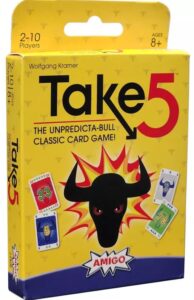
Take 5, which was initially and for a long time called by its German name, 6 nimmt!, is a game I initially rated 6/10. This more-or-less means I thought the game was fine, and that I wouldn’t be upset at playing it but would never truly be looking forward to it. Nor would you find me suggesting it.
I was wrong.
Some of the gripes that informed that earlier, more tepid reaction are things I’ll discuss in this article. It’s not that these flaws don’t exist, it’s that the game at its best washes them away in a cacophony of laughter and good-natured groans.
Take 5 – Gameplay
Each player starts with 66 points and is dealt a hand of 10 cards, numbered 1-104. The goal is to lose the fewest points when someone reaches zero points, which is usually after a few rounds.
On turns, players select a card and reveal it simultaneously. These are placed into one of four rows that have a “seed” card that starts the row. A couple simple rules dictate how placement works.
The goal is to avoid being the 6th card placed in a row, forcing you to take the five cards already in the row, which will equal a variable number of negative points at round’s end.
The structure is simple and gameplay is fast and largely simultaneous. The game plays in under an hour at any player count, and can approach 30 minutes in faster sessions.
Player Count Considerations
If you’re familiar with the game or read that description above, you might be thinking that a lot of the outcomes will be arbitrary. If there are eight other players, and your placement of card depends largely on what they play, how can you predict this?
The answer is that you can’t. Well, sort of.
Near the highest player counts, nearly all of the game’s cards will be in play (and all of them will be at its full 10 players), so if an 84 is sitting there as the 4th card in a row, and you have the 86, you can be reasonably sure someone is going to sneak in with the 85, causing you to bust as the 6th card in the row if you play your 86.
Similarly, knowing when and why to play a low number wherein you’re forced to take a row, but likely one only worth 1-2 negative points, can be a life-saving tactic that avoids the more punitive moments of 4-10 negative points.
Then you have your lower player counts, where fewer cards will be in play, but there is less you need to predict and so there are moments where you can sort of instinctively apply some approximate napkin math, in order to make an informed decision.
So if it feels chaotic at its higher player counts, you’re right, but you may also be missing some opportunities to glean small insights that can inform play.
Tactics, Strategy, Randomness, and Caprice
None of this is guaranteed, which is where the game’s tension and hilarity comes from.
The game’s best moment will feature someone smugly content with their cardplay, only to watch as the cards before them fall in a precise way to stick them with an onerous number of negative points. Groans, cheers and laughter abound in these moments.
What’s more, such moments are guaranteed by the game’s structure. It’s not a matter of “if” they’ll happen, but when and to whom.
This means it will feel random to some, and while my notes about tactical considerations above do apply, the truest response to this criticism is that, yes, a lot of outcomes are unpredictable and capricious.
I think there’s more psychological nuance under the hood of this game than some give it credit for, but a large part of the appeal is simply going along for the ride and seeing what happens. A party-game mentality is a prerequisite to getting the most from the experience, but this will be at odds with those looking for more calculable strategy.
For a while this is why my preferred player count was on the low end, perhaps 3-4 players. I felt like I had more control over what happened. Whether true or not, letting this need go and simply playing by gut instinct at higher counts eventually became my preferred way to play.
The game rewards both approaches though, and so it’s the rare game with a huge player count range (3-10 players) where I can truly say it works well at any player count in that range.
Upkeep and Scoring
Usually when I play, I’m teaching, and I’m also facilitating things so that the game runs quickly. But imagine having to move around eight different peoples’ cards every turn, cue everyone to flip their card 30-40 times in a game, and track scoring after each round.
Then imagine trying to just sit back, relax and enjoy the game while doing all of that.
My first couple times playing, I was a game manager, so to speak, and didn’t feel like a player. This detracts from the experience, even though I’m able to enjoy games in part because others are enjoying it.
This is a gripe I still have with the game, but fortunately it lessens once you play with enough people who know what’s going on. In the confines of one particularly monthly meetup where we played perhaps four times in a span of five months, everyone absorbed the rules and cadence, and anyone new was onboarded quickly by others, reducing the need for me to reiterate rules. They would move cards and handle turn-to-turn upkeep without me.
Then, free to laugh and relax, the game became its best self for me.
Take 5 and/or 6 Nimmt – Conclusions
This is one that’s requested periodically at the meetup mentioned above, and has become a reliable game in a variety of situations. One friend calls it “the explodey game” owing to how busting feels when you’re the 6th card in a row.
Its generous and flexible player count and small box size and rules overhead also make it an easy recommendation for numerous groups.
It’s not without quibbles related to the facilitation of play, particularly at higher player counts, but it’s one where it’s worth pushing through these issues with a group that will appreciate its particular brand of chaos.
…
Like my content and want more? Check out my other reviews and game musings!
Read More From BTD
Recent Posts
Categories
- All (370)
- Announcements (4)
- Board Games (217)
- DMing (29)
- Game Design (21)
- Playing TTRPGs (22)
- Reviews (203)
- RPGs (145)
- Session Reports (92)
- Why Games Matter (13)