Vijayanagara: The Deccan Empires of Medieval India, Game Review

By MARK WILSON
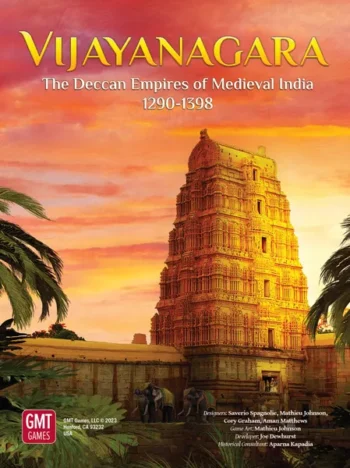
Game: Vijayanagara: The Deccan Empires of Medieval India, 1290-1398
Released: 2024
Players: 1-3
I’ve covered a COIN game – short for counterinsurgency – once before, in my review of Gest of Robin Hood. Vijayanagara is my second foray, within the even more specific “Irregular Conflict” series from GMT Games, a shorthand name for a spinoff line of COIN titles.
Let’s start at the beginning for those who are beginning to get confused. COIN games generally feature two or more factions in some historical setting. There is an established power, and one or more other factions are working to overthrow that power. Thus, the “insurgent” portion of the label. In Gest, for example, Robin Hood and his band of thieves were the insurgents; the Sheriff and his, the ruling oppressors.
History doesn’t slot neatly into “good guys vs. bad guys” in most of its conflicts (even Gest is a little murky in this regard when you drill down), but it does give us plenty of examples of a ruling power being challenged by upstart forces. So it’s fertile grounds for conflict simulation.
The last quirk of these games is that they’re asymmetric. Meaning, there are certain mechanics that are germane to all factions, but each faction has their own set of abilities that are unique to them. This is intended to make play feel meaningfully different depending on which side you play as.
Vijayanagara, an Overview
Here, the factions are the Delhi Sultanate, the Bahmani Kingdom, and the Vijayanagara Empire. The game depicts a little over a century of fomenting unrest and conflict as the Sultanate loses its grip on India.
A fourth pseudo-faction exists in the form of invading Mongols. These forces batter the walls of the Sultanate like waves crashing against the shore, and are controlled in minor ways by both of the other factions.
The Sultanate controls everything – no, everything – at the game’s start. However, their more tenuous hold on the fringes of their empire crumble quickly as the other two get to work.
It’s all very high-level action, abstracted out through decades and eras within them. You get the sense of rebelliousness, but are never asked to look at it up close and personal. Gest is the opposite, even wrestling with some morally questionable acts from its supposed protagonist as his followers rob and pillage. Vijayanagara never asks for such introspection; this is, likely, the correct decision given the span of time covered, but ends up feeling a little less personal in its dealings.
The factions have a menu of action options, and there’s also an event card drawn each round that presents a juicy action option to consider. These can only be taken by one player, and chaining together multiple actions from the faction menu in a turn will cause you to have to sit out the next turn. So there’s tension in the action economy of the game as players decide when to take minor actions in order to avoid skipping a turn, or go for broke with the game’s most momentous events and maneuvers.
Asymmetry and Its Forms
Playing as the Sultanate vs. the other two factions feels extremely different. You’ll feel invincible early on, but by the midgame you’ll wonder how you’ve let so many regions go neglected, and will start to look with increasing worry at the Mongol invaders knocking at your door.
However, the Bahmani and Vijayanagara have similar-enough action options and paths to victory that they feel much more of a stand-in for one another in the game’s design.
This is neither good nor bad. The promised asymmetry is here, though I couldn’t help but feel a tiny bit more freedom as both the Sultanate and Bahmani Kingdoms, owing to their starting positioning on the map. Vijayanagara has plenty of potential for victory, but the window of viable strategic approaches feels meaningfully narrower. Experienced play may refute this, but I find it uncontroversial to say that many will fall into similar patterns with this faction.
The Dynamics of Multiplayer Scheming
It’s also asymmetrical in terms of alliances. This isn’t a 2-on-1 game, but in the early turns, it functionally is. When, why, and where you turn on the other upstart kingdom – provided you’ve done your job in humbling the Sultanate sufficiently to make it a true three-way contest – is intriguing.
As an aside, this is a game for 1-3 players, and while I have no doubt an engaging solo session could be made of this game (I don’t generally play solo, so this review won’t cover that), to me the chief appeals of Vijayanagara rely on the interplay of multiple competing players.
This also allows for something I didn’t detect in Gest of Robin Hood. See, in a 2-player game, everything is zero-sum. Add just one more player, though, and you’re going to have to ignore whoever’s “losing” at various points.
This allows for more dramatic comebacks and the whims of Fate (dice rolls in combat) and action selection hurt some more than others.
I do suspect there are also opportunities to kick a faction while it’s down, since the easiest land grab might not be from the player winning but rather the one doing poorly. This would refute my observation above, and seem eminently possible. However, insofar as our usual instinct is to target the person with the most points, I think these instances will be rare in games. The risk is too great that you end up squabbling for 2nd place instead of vying for an outright win.
Freedom & Restriction
Vijayanagara has good instincts. It deals elegantly with turn order on the event cards, has inherent variability owing to the order in which the events roll out and also the variance of combat. The dice are manipulable via one of the game’s minor resources, so the sting of poor rolling should never be too harsh. But you’ll also find yourself having to pivot away from a plan into another when something goes more awry than expected.
This is all good. The emergent dynamics of three players also push the game into territory that make it an easier COIN recommendation for me than Gest of Robin Hood, even with the latter’s higher accessibility (in theme, certainly, though mechanically the two are similar in rules density).
Conversely, while restriction breeds creativity and I appreciate its application in many games, there are limits here that hurt the game in some small ways.
One may be germane to COIN games in general: the events. Many are powerful, interesting, and exciting to execute. So what’s the issue? Well, it’s that they seem almost predetermined to elicit swingy drama, but in roughly equal amounts for all factions. So, too, with the degradation of the Sultanate and Mongol invasions. There’s a cadence that feels more-or-less destined to recur with only minor variances.
For some this won’t be an issue at all, as it results in some dramatic gameplay. For others, though, the fact that some of this drama feels scripted instead of an organic result of player actions will take some slight sheen off of the headiest moments.
I felt the tug of this disappointment, but was never fully convinced of it. This is an assured game, and to paint it as a game without tactical and strategic creativity would also be wrong.
Also juxtaposed with Gest, which unfortunately feels a bit more scripted in its deck construction and pseudo-reset rounds (Vijayanagara has these “interrupts” as well, but they never feel quite as jarring), I was pleased at how the game seems to trust its players to create a narrative together. I suspect the resets in Gest are again due to it being a 2p game, and thus for balancing reasons that don’t need to exist in more fluid 3-5p settings, so it’s no fault of the designer, but also seems to point to some of the limits of the COIN system as a whole. It functions best at more than two players for me, and I suspect it will for many others as well.
Vijayanagara, Conclusions
I like both of the games I’ve been discussing, if that wasn’t clear. But COIN is becoming more mainstream in modern gaming, albeit still within a specific niche of it. Diehards who are playing multiple COIN titles dozens of times each do not need to parse between them to determine which is most worth owning or playing.
But for those of us who aren’t tabling games like this with enough regularity to justify owning several, their strengths and weaknesses matter, even if we have to nit-pick a bit to get at the specifics.
In my heart of hearts, I want even more of an open sandbox with the types of mechanics present in Vijayanagara. Perhaps this would feel too unhistorical. We don’t always end up enjoying what we think we want. Adding even more players also intrigues me, though I worry a bit at what could be some procedural bloat with more complicated designs of this type.
Still, Vijayanagara – despite featuring a setting and period that’s opaque to most of the audience this review will reach – is not the intimidating mastodon that COIN’s equally-opaque reputation may suggest it is. It’s a fascinating exploration of conflict, strategy, and one’s ability to balance mutual benefit with aggression toward multiple foes, and it’s accessible enough to reward play at a variety of experience levels.
…
Like my content and want more? Check out my other reviews and game musings!
Read More From BTD
Recent Posts
Categories
- All (370)
- Announcements (4)
- Board Games (217)
- DMing (29)
- Game Design (21)
- Playing TTRPGs (22)
- Reviews (203)
- RPGs (145)
- Session Reports (92)
- Why Games Matter (13)